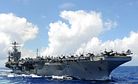
The AirSea Battle concept for countering China’s military rise is expensive and unhelpful. And could even spark a nuclear conflict.

The officer, a senior leader in US Pacific Command, looked down, fumbled with his papers and shifted uncomfortably in his seat. It was 2009, and he was answering a question about whether, in a Taiwan Straits crisis similar to that which occurred in the mid-1990s, the United States could confidently respond by again deploying aircraft carrier groups around Taiwan. ‘No,’ he conceded after a long pause, ‘and it’s the thing that really keeps me up at night.’ It was a telling response.
Indeed, while China’s new aircraft carrier grabs all the attention, the People’s Liberation Army’s maritime denial strategy is quietly maturing, leaving the United States facing some difficult choices. As submarines and precision-guided strike capabilities accumulate in Chinese arsenals – and are woven into war plans – the US capacity for sea-control and power projection in the Western Pacific, long taken for granted, is steadily being eroded. As a consequence, new doubts are emerging about the credibility of certain US strategic assurances, particularly in relation to Taiwan, which other US allies use as a barometer of Washington’s regional commitment. In this regard, China’s denial strategy is undermining the military, and hence political, foundations of US primacy.
This situation hasn’t arisen overnight. The most pronounced shifts in the military balance have, however, occurred while the United States has been preoccupied elsewhere – and in the context of a longstanding but unrealistic expectation on Washington’s part that China would be a different sort of great power, one that eschews power politics, like Japan, in favour of a more deferential posture.
Today, all aspects of that situation are changing. The advent of certain high-profile Chinese capabilities, together with Beijing’s newly uncompromising demeanour, suggests that China is under no illusions about the means to success in international politics, and is cut from the same cloth as its great power predecessors. It also means Beijing can no longer maintain such a low-profile in US strategic headlights.
With the wars in Afghanistan and Iraq drawing to a close, US attention is gradually refocusing on Asia. As it does, some strategists have begun re-evaluating the centrality of power projection in US strategy. In particular, they are asking: what does it mean for the United States and its allies to lose military primacy in the Western Pacific? Does US credibility depend on the ability to dominate China’s maritime periphery? And what are the implications of a military no-go zone in the Western Pacific?
These are questions that Washington will, in time, be forced to answer. In the meantime, the US Navy and Air Force have begun preparing AirSea Battle contingencies, a war-fighting doctrine aimed at countering China’s denial strategy. By denying China’s capacity for anti-access, the United States intends to preserve its options for sea-control and power projection, reinforcing its primacy and role as the region’s guarantor of free navigation. This decision, in turn, reflects a deeper, more quixotic judgement that such an objective is both vital to the United States and attainable at a level of cost and risk commensurate with US interests in the region.
On both counts, though, there are reasons to be sceptical. First, the cost of AirSea Battle is likely to be prohibitive. Though it remains a largely notional concept, AirSea Battle will depend on an expansive set of upgraded capabilities: a hardened and more dispersed network of bases and C4ISR systems; more and better submarine, anti-submarine and mine-warfare capabilities; and new, long range conventional strike systems, including bombers and anti-satellite weapons. Then, of course, there are the aircraft carriers and other major surface combatants, strike-fighter aircraft, and possibly even amphibious ships.
Photo Credit: US Navy
View as Single Page
Aaron Bouma
As the situation continues, we should expect that China will deploy more DF-21D anti-Ship Ballistic Missiles. (ASBM)s. This is certainly one way the Chinese are countering the US Navy Carrier groups.
Major Lowen Gil Marquez, Philippine Army
All battle plan has a dangers. if such plans will be process and converted or becomes now an OPERATION ORDER its output will rtesult to the risk and danger, but it will make more favorable to those who has a better plan and implementation order, air sea battle is costly but it go to the process, the US has the most and advance doctrine in the world, so how even dangerous it is as long it will benefit the rest of the world and then go…
Brendan
I feel like in the event of a minor break out of war.china will not be able to stand its ground along the coast due to the fact that china has just really started in building its navy , the us has been building its navy after the spanish american war see the difference
Yamato Kira
The real loser in this quest is neither China nor US, it is the smaller countries that will be use as pawns. But this can also be an opportunity to smaller countries in expanding its military capability :-)
Brigadier Arun Sahgal (Retd)
In any scenario of confrontation, either side has to make the first move. If Chinese have to execute AA/AD strategy the they will have to launch preemptive attacks to deter US forces build up. Similar action would be required by the Americans in their Air – Sea Battle concept. Moot question is who will blink first in the period leading up to deployment of forces.
Given the inherent deterrence potential of the standoff, it will be a difficult decision to cross threshold and launch the first strike. Two aspects are important taking all political factors into account. First, period leading up to the crisis and the way regional and international dynamics play out will provide nature and level of escalation. second and more important will be the function of perception of relative power and political resolve of leadership. shooting war will be a function of deterrence breakdown with huge implications for regional stability. Either side will find it difficult to back down fearing geopolitical los of face fearing international standing.
C. L. Staten
Brigadier: Sir, your points are most salient, which is why it is so important the U.S. administration is seen by the world (and especially China), to be true to their word and not reluctant to engage…should that prove necessary. The world's intelligence analysts hang on to every word that comes from the American White House in order to assess the actual resolve and level of truthfulness of U.S. official statements.
Dave Chan
There is really no point for US and China to enter into any form of military conflict. China is minding her own business in this part of the Pacific. US is coming to China's doorstep to pick a fight. Having been subject to foreign invasion for a century from 1840 to 1945, China will certainly make sure this will not happen again. At all costs. It is deplorable that US and many western countries fail to perceive the resolute of the Chinese people in the backdrop. Another thing about China is that she is very good at asymmetric strategy. People conversant with Chinese history know.
Imran Abubakar
seriously? your comments are all fake just like China
slim
This "There is really no point for US and China to enter into any form of military conflict" is fine. The rest, except the asymetric bit, is way, way off. China is harassing the peace east and south.
nil dagoy
the PHILIPPINES' 7000++ islands is a willing ENORMOUS AIRCRAFT CARRIER that can cover the whole West Phil Seas in that conflict. That is a concept.
Memo
Frank, I would like to ask, rptfecseully, that you participate in serious discussion instead of deliberately trying to ruin the discussion with comments that you fully know are inane and illogical.