


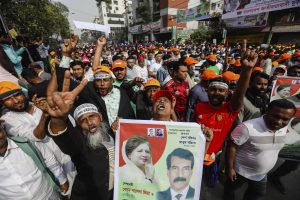
Prime Minister Sheikh Hasina has announced that the next general election in Bangladesh will take place in January 2024. This means that we should anticipate contests in all 300 parliamentary constituencies six months from now. Given the scale of the country’s polity, such a large-scale general election typically involves extensive preparations, campaigning, and resource mobilization. However, it is peculiar that even residents of Dhaka, the capital city, have not observed any indications that an election is on the horizon. Moreover, there is minimal discussion in the mainstream Bangladeshi media attempting to predict the possible electoral outcomes in 2024.
The lukewarm interest of the Bangladeshi population in the general election can be explained through a retrospective analysis of the country’s recent political history.
The fall of President Gen. Hussain Mohammad Ershad’s regime in December 1990 led to an era of competitive civilian rule, whereby Sheikh Hasina and Khalida Zia alternated as prime minister from 1991 until 2006. The 1991 election was held under the stewardship of Acting President Shahbuddin Ahmed operating in a non-partisan capacity. The Bangladesh National Party (BNP) government led by Zia passed the 13th amendment to the constitution of Bangladesh in 1996, as demanded by the opposition Awami League. This provision required the Jatiya Sangsad (parliament) and the Cabinet to be dissolved 90 days prior to a general election, and the state to be administered by a neutral interim caretaker government.
The incumbent BNP government lost the June 1996 Bangladeshi general election to the Awami League, allowing Hasina to become prime minister for the first time with the support of the Jatiya Party (JP). In the 2001 general election, the incumbent Awami League was defeated by the BNP, and Zia became prime minister for the second time.
It is noteworthy to mention that no incumbent government has ever won successive terms in a general election held under the supervision of a neutral caretaker government.
The BNP government made various attempts to tweak the caretaker system in Bangladesh to its advantage. These attempts included extending the retirement age of the chief justice of Bangladesh from 65 to 67, to suit its preference for former Chief Justice K.M. Hassan to be appointed as caretaker chief adviser, instead of Chief Justice Mudassir Husain. As Hassan refused to serve as caretaker chief adviser, then-President Iajuddin Ahmed appointed himself to the post, thus making him both the head of state and government.
The caretaker government led by President and Chief Adviser Iajuddin Ahmed failed to conduct the 2007 general election due to the ongoing constitutional crisis, deteriorating law and order situation, and the decision of the Awami League to boycott the election. These elements forced Ahmed to relinquish his position as chief adviser while continuing as president. The caretaker government of Ahmed was replaced by an interim technocratic government led by Caretaker Chief Adviser Dr. Fakhruddin Ahmed and backed by Chief of Army Staff General Moeen Ahmed. As the caretaker administration of Dr. Fakhruddin Ahmed seized power on January 11, 2007, it is infamously referred to as the 1-11 government.
The 2008 Bangladesh general election, which gave the Awami League a landslide victory, was held under the auspices of the 1-11 government. This was the last free and fair election in Bangladesh umpired by a non-partisan, neutral caretaker government.
As the Awami League enjoyed a supermajority in the Jatiya Sangsad – and given the strong anti-incumbency tendencies in the Bangladeshi electorate – it is no surprise that they passed the controversial 15th amendment to the constitution of Bangladesh, abolishing the caretaker system as provided by the 13th amendment. The 2014 Bangladesh general election was the first election since the June 1996 general election to be held without the formation of a neutral non-partisan caretaker government.
The BNP decided to boycott the election, knowing well enough that it is near impossible to conduct free and fair elections without a caretaker government in Bangladesh. There was some false expectation from the BNP that the 2014 election would either be annulled or that the Awami League could be pressured to call for fresh elections under the caretaker system. This would have been similar to the February 1996 general election, which was boycotted by the Awami League and its allies, thus forcing the BNP to amend the constitution and call for an election under the Caretaker system.
On the contrary, the 2014 Bangladesh general election was a walkover for the Awami League and its coalition partners, with the participation of the Jatiya Party represented by former President Hussain Muhammad Ershad and his wife, Rowshan Ershad. Rowshan Ershad has served as leader of the opposition in the Jatiya Sangsad ever since, aside from a brief stint where she was replaced by her husband from January 2019 until his death in July 2019.
It is widely known in Bangladesh that Hussain Muhammad Ershad was coerced to participate in the 2014 election. With the Jatiya Party taking part in the polls, the Awami League regime was able to create the façade of a democracy and ward off criticism of turning into a one-party state. There were also speculations in the international community between 2014 and 2018 suggesting that if the BNP had contested the 2014 general election, it might have won a considerable number of seats to the extent of at least denying the Awami League a two-thirds majority in the Jatiya Sangsad. Such assumptions and speculation, which were commonly discussed and even promoted by Bangladeshi diplomats around the world in the aftermath of the 2014 general election, gave the Awami League regime the benefit of doubt.
The BNP was well aware that participating in the 2018 general election without a caretaker administration in place was tantamount to giving the incumbent government another walkover. As such, the BNP opted to take part in the 2018 polls, although top leader Zia was prevented from running due to a conviction on corruption charges.
It is now established beyond any reasonable doubt that massive rigging and poll irregularities were involved in the 2018 general election. The BNP and other opposition parties thus managed to prove why they had boycotted the 2014 election, validating their argument that a free and fair election cannot take place in Bangladesh without a non-partisan caretaker government in place. However, seven BNP Members of Parliament still took the oath and enjoyed all the privileges of elected office while challenging the legitimacy of the legislature. They have only recognized this folly recently and resigned from parliament in December 2022.
The BNP has repeatedly declared that it will boycott the 2024 general election if it is conducted without a neutral non-partisan caretaker government, just like it did a decade ago in the 2014 Bangladesh general election. So, it is now clear that a repeat of the 2018 electoral model is off the cards.
A replay of the 2014 election in 2024 is also unlikely, given the increasing pressure from the United States for competitive elections in Bangladesh. The U.S. interest in promoting the democratic process in Bangladesh can be seen from the sanctions imposed in December 2021 on the Rapid Action Battalion for serious human rights abuses and the statement by Secretary of State Antony Blinken on May 24, announcing a new policy enabling the U.S. to “restrict the issuance of visas for any Bangladeshi individual believed to be responsible for, or complicit in, undermining the democratic election process in Bangladesh.” This shows that Bangladesh has now earned itself an international reputation for rigging elections.
At this juncture, neither a recreation of the 2014 nor 2018 electoral illusion is an option for the Awami League. This means that a new game will be played in January 2024, as understood in the Bengali slogan “khela hobe,” meaning “the game is on.” It will be highly interesting to observe the forthcoming development in the domestic politics of Bangladesh in the second half of 2023 until the proposed January general election – if it takes place.