


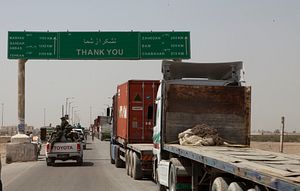
Afghanistan and Iran are nearing the conclusion of a major bilateral strategic cooperation agreement that would see the two expand their trade and transportation links. Afghan President Ashraf Ghani met with Iranian Foreign Minister Jawad Zarif in Kabul on Tuesday to finalize the terms of the agreement. Zarif additionally extended an invitation for Ghani to visit Tehran. In Kabul, Zarif also met with Afghanistan’s Chief Executive Officer (CEO) Abdullah Abdullah. According to Afghanistan’s Pajhwok News, Ghani stressed “cooperation on issues of counter-terrorism, drugs, refugees, economic links and transit trade” in his meeting with Zarif.
The bilateral cooperation agreement would build on a similar August 2013 Memorandum of Understanding (MoU) that was signed between the heads of the National Security Councils of the two countries when Afghan President Hamid Karzai was in power — shortly after the inauguration of Iranian President Hassan Rouhani. The 2013 agreement emphasized expanded bilateral cooperation on military, intelligence, and economic issues. Significantly, the 2013 agreement was primarily a security agreement — it emphasized cooperation in military training, combating terrorism and organized crime, and even referenced joint military exercises. These exercises, according to the agreement, would help the two countries come together to fight “against the shared threats of terrorism, narcotics and others.” The 2013 agreement also provided for intelligence sharing between the two countries on “developments in the field of threats for national security… including in Central, West and South Asia.”
Since the 2013 MoU, relations between Afghanistan and Iran have been largely stable despite Iran being one of the only major regional powers opposed to the U.S.-Afghanistan bilateral security agreement (BSA) that will see some 10,000 U.S. troops stay on in Afghanistan through this year and possibly into 2016. It would make sense for Iran to continue to build on the common understanding of the 2013 MoU with the pending strategic cooperation agreement. Both sides have identified a range of important security topics that warrant increased bilateral cooperation. On economic interconnectivity and trade, the two sides will likely discuss Afghanistan’s access to seaborne trade via Iran’s Chabahar port.
Interestingly, Zarif noted in Kabul that Iran would be interested in organizing a joint force with regional states to “contain extremism,” according to Pajhwok. He additionally noted Iran’s interest in helping Afghanistan contain its poppy cultivation and opium smuggling problems — Iran has had the highest per capita number of opium addicts of any country in the world. Iranian efforts to stem the problem domestically have largely been ineffective given that opiate products continue to illegally cross the border from Afghanistan into Iran.
Ghani will likely travel to Tehran soon — perhaps as early as February — to conclude the strategic cooperation agreement.