For years the Iran factor in North Korea's ballistic missile program has been hiding in the open.
North Korea’s successful launch of a long-range missile has turned a hypothetical into an emerging reality. Recent U.S. intelligence estimates warned of a North Korean missile capable of reaching the shores of Alaska and Hawaii in a few years. Failed missile tests since 1998 had inoculated many observers with the belief that North Korea’s long-range missile development program had more bark than bite. Pyongyang had been reportedly using missile tests as a bargaining chip rather than as part of a concerted effort to attain long-range capability. North Korea’s leap forward in mid-December, however, clearly demonstrates that the nascent Kim Jong-un regime is on a credible path to further improving its long-range missile capabilities.
How did Pyongyang pass the chronically elusive threshold of completing a three-stage rocket test and placing a satellite in orbit?
The Iran factor has been hiding in the open.
Cooperation between North Korea and Iran has been a critical — yet under examined — enabler of the recent success. What started as a transactional relationship, where Iran provided much-needed cash to North Korea in return for missile parts and technology, has evolved into an increasingly effective partnership. The time has come to view their previously independent ballistic missile programs as two sides of the same coin.
Client Becomes Partner
Although sporadic cooperation between North Korea and Iran on missile development has been well documented, analysts viewed this interaction largely through the lens of serial commercial transactions. The conventional wisdom was that cash-starved North Korea found a lucrative client in Iran. As a result, analysts tended to view the two pariahs’ long-range missile development programs as largely independent endeavors. However, North Korea’s sudden success on December 12th was not the result of good fortune but rather was the fruition of its increasing institutional cooperation with Iran. In September 2012, North Korea and Iran signed a scientific and technological cooperation agreement. Largely dismissed as a propaganda ploy, it provided an organizational framework to set up joint laboratories and exchange programs for scientific teams, as well as to transfer technology in the fields of information technology, engineering, biotechnology, renewable energy, and the environment. In practice, the projects created a cover for these regimes to weather U.S.-led sanctions related to missile-proliferation activities. The new bilateral agreement thus appears to have formalized a recent mechanism through which both regimes had been regularly procuring specialized components, as well as sharing technical data and expertise. When one side masters or acquires a key missile-related technology, the other now institutionally benefits.
Further technical analysis is likely to show that North Korea’s recent success was rooted in Iran’s orbital launch of its Omid satellite atop the Safir satellite carrier in February 2009. This landmark event was itself likely facilitated by Russian missile cooperation with Iran in the 2005 period. Under the innocuous title of “civilian scientific and technological cooperation,” the North Korea–Iran agreement provides a conduit for Pyongyang to access earlier Russian inputs into the Iranian program. Of particular significance to North Korea is Russia’s proven long-range missile technology. The fact that North Korea’s rocket reportedly used red fuming nitric acid as a propellant further underscores this possibility.
This bilateral partnership — and mutual reliance — is unique in the international community, especially given that North Korea and Iran lack any common ideology, religion, geographic space, or ethnicity. An overlooked reality is that each has helped the other cope during national emergencies. For Iran, North Korea was a vital supplier of conventional arms during the Iran-Iraq War. For North Korea, Iran has been a long-standing linchpin in Pyongyang’s vitally important procurement activities in the Middle East and Eastern Europe — a role that China is now increasingly playing as a result of more foreign companies setting up production facilities targeting the growing Chinese market.
Conclusion
What is to be done? The U.S. response to the fused North Korean and Iranian missile programs will require innovation and adaptation to better understand this new reality. The following initiatives could help bridge gaps resulting from obsolete frameworks of analysis:
– The United States needs to identify and track the primary North Korean and Iranian state trading companies engaged in operationalizing the September 2012 agreement. Many analysts have traditionally examined supply chains, logistics, and procurement as separate activities. An integrated approach to analyzing the full life cycle of a North Korean–Iranian transaction is long overdue — and now possible given access to key defectors in Seoul who have worked in North Korean state trading companies.
– Building on improved understanding of how the fused missile development programs function, policymakers can structure new incentives to disrupt critical sections in the life cycle. Rather than rely solely on a sanctions-based policy of “strategic patience,” the United States should consider innovative programs aimed at de-incentivizing participation for private Chinese companies in third-party countries that serve as vital middlemen in key transactions.
One incentive that may prove fruitful is a monetary reward program to interdict components or technicians central to ballistic missile development. Hiding in the open is a particularly effective tactic employed by North Korea. Contracting private Chinese companies to serve as middlemen to facilitate “cargo laundering” — a creative process of disassembling components and moving them through different logistics routes — enables North Korean state trading companies to utilize commercial shipping containers. Monetary rewards would offer a double payday for some Chinese companies, who could collect the commission fee from a North Korean client as well as the reward for anonymously providing a copy of the freight insurance to local authorities in busy Southeast Asian ports.
Only by engaging in innovative research can we generate the understanding and insights required for developing such new policy tools. Overreliance on sanctions has resulted in the focus shifting from objectively measuring their effectiveness to attributing any setback the target regimes face to the sanctions. A crude North Korean satellite currently in a polar orbit is a wake-up call for the United States.
John S. Park is Stanton Nuclear Security Junior Faculty Fellow in the Security Studies Program at the Massachusetts Institute of Technology. This article originally appeared on the website of The National Bureau of Asian Research as an NBR Analysis Brief.
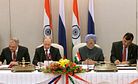
Photo Credit: Office of Iran's President

Chris
Pretty soon the whole world will have the know how … it's only a matter of time. Then what?
Does that put the world at a level playing field? Let's think back in history. Two tribes fight because one wants more land / resources, one tribe comes up with a better weapon. They can then hold their ground and take the others, but fighting usually subsides because they can't compete.
If the world can't all live together in peace then we'll all be fighting against each other in war.
Jihad
Yeah, people don't know about Teheranno. That's a Tehran connection in Seoul. In fact, it states that both of these countries are actually related, but nobody seems to know. That's why North Korea have good enough relations w/ Iran. Don't ever trust the Azlams.
simon bolivar
So where does the world get off saying what our goverments do or do not do. if we set back and do nothing or we set back and offend our cultures and do nothing to quit shedding more blood ie., war in it self is a racket.. to make money on death with the rich to gain and its people to suffer of there own countries… Im american but are we a people of war and gain from war… as a whole judgement on the part of your own goverments in what they do is out of your control………..period!!! vote does little when the rich control every thing in each country (colombia with farc example thats how it will in end up for the usa… my thought…. i lived there i saw goverment at work on there people …… opressed control with taxes war with farc and several factions 100 more when there gone the rich wants them there for the drug trade .. mexico imports exports every thing to with war and death….this is our world blood more blood there will never be peace when there are rich an powerfull peple in power to controll its mass we as sheep will follow out of hunger and fear.. but we all in every country must love each other as brothers to change this but that is a pipe dream!!!!!!
Awaken
I dont understand what the fuzz is about, what happens if these countries develope and progress in missile and nuclear technology, whats wrong with that?
I think only if you feel that all nations are not equal and do not have same rights you can justify cirtisizing , otherwise it should be natural that all nations have right to develope whatever they want within their own borders….the west is destroying and threathening 3rd world nations only because they make the horrible crime that is progressing in technology. Bad bad countries who want nuclear tech and missile tech….shouldnt they know its only for western countries? shouldnt they understand that only west has rights….you are only slaves for west? When will they wake up ad be rational and understad they are only slaves with no rights…and submitt to the grand lord west!
simon bolivar
you ment saudis they own the usa with there oil money and contracting the usa for war… jump when we say bomb whom we say.. they will give contracts for the defence department usa and rich political congrees whom have stocks and shares in the weath of war and blood lust…….
imy
well, this is still be the phase that the weapons of mass destruction still control the balance of power.