


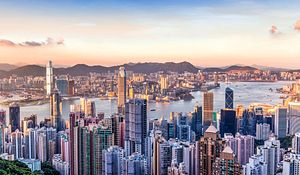
For decades after 1949, Hong Kong—also known as the “Pearl of the Orient”—was the envy of mainland Chinese because of its prosperity and freedom. It was naturally the top destination for hundreds of thousands of mainlanders who tried to flee from famine or political chaos.
Hong Kong also used to evoke feelings of poignancy among mainlanders, because it was under British colonial rule for nearly a hundred years. Thus, when it was reverted to Beijing on July 1, 1997, there was a genuine outburst of national pride across China. A page of humiliation was finally removed from Chinese history.
The return of Hong Kong took place against the backdrop of China’s miraculous economic take-off. A decade and half of breakneck growth after 1997 has transformed China into the world’s second largest economy and the biggest trading nation. Beijing, Shanghai, Guangzhou rapidly developed into regional—if not global—financial and industrial centers, whose prosperity seems to rival that of Hong Kong.
One of the “Four Asian Tigers,” Hong Kong’s economy took off in the 1960s. It is fair to say, though, that the island greatly benefited from an impoverished and closed China. Before reform and opening up in 1978—and for many years thereafter—Hong Kong functioned as the most important intermediary trading center for the mainland’s imports and exports. It was the premier agent for China’s economic interactions with the outside world.
But Hong Kong’s good fortunes soon ran out. During the same period that saw China become an economic powerhouse, Hong Kong stagnated. Whereas movies, music, and fashion from Hong Kong—to take one example—absolutely dominated the China market up until the late 1990s, today most mainlanders look to Hollywood, Seoul, or Tokyo for the trendiest products.
Meanwhile, postwar years of prosperity, coupled with British-imposed political and legal institutions, have endowed Hong Kong residents with a strong sense of superiority vis-à-vis their brethren across the border. Prosperity has gone, but superiority remains. With millions of newly-empowered Chinese tourists pouring into the tiny island every year, however, that deep-rooted sense of superiority is being challenged daily and quickly eroded.
While the average Hong Kong resident is struggling to pay monthly rent, the average Chinese tourist seems to be flush with cash and confidence. An old way of life is fading, and a “new normal” is emerging, though many local residents are unwilling and/or unable to adapt to the new normal. The island of fragrance—the literal meaning of Hong Kong (香港) in Chinese—now smells of frustration, resentment, and anger. From intimidation and harassment of mainland tourists, to the Occupy Central, and then to the riots a week ago, Hong Kong is fast becoming a city on the edge.
Under such circumstances it is tempting for some Hong Kong residents to blame Beijing. Admittedly, Beijing has some promises to fulfill, particularly when it comes to electoral reform. But the central government—and for that matter mainland Chinese—played a small role in the myriad problems facing local residents, from appalling inequality to skyrocketing rent to declining wages. There are strong indications that Hong Kong has become, unfortunately, another example of “winner-take-all-politics,” primarily because local politicians and business elites have turned their back to the average resident, making the rich richer and the poor poorer. The global financial crisis only made the winners win more, and the losers lose more. It is time for Hong Kong residents to hold these officials and business elites accountable, instead of pointing fingers at Beijing.
Some may argue that without universal suffrage and electoral competition it is difficult to have accountability, hence Beijing’s responsibility for Hong Kong’s problems. Yet one can have accountability without elections (as in the case of China). Also one can have competitive elections without accountability (as in the case of the United States). More importantly, the key components of the existing political institutions governed Hong Kong throughout the British rule, but local residents appear to have been happy with them. No wonder some mainlanders accuse some radical agitators in Hong Kong as traitors who prefer to live in the shackles of colonial rule.
So whither the “Pearl of the Orient”? Anybody who has been to Hong Kong will hardly fail to notice that its streets are crowded with shops that sell cosmetics, electronics, pharmaceutical products, and luxury goods. Yet most of these products, it turns out, are not made in Hong Kong. This speaks volumes about the Achilles’ heel of Hong Kong’s economy: it has neither a formidable industrial base nor a competitive information industry. To be sure, it has a big service industry, but that industry provides mostly low-paying jobs: catering, retail, tourism, and so on. To revitalize its economy and to redistribute wealth more equitably, Hong Kong needs much more than a vocal and cynical minority that barks up the wrong tree.
The golden days of the “Pearl of the Orient” may be gone, but the rise of China does not necessarily entail the decline of Hong Kong. After all, they are geographically, economically, and culturally too intertwined to have fundamentally different fates. At the same time, it is imperative that leaders in Beijing confront an inconvenient but important question: Why is a more affluent China apparently becoming less attractive to the people of Hong Kong? To ignore this question is to reject the opportunity to make Hong Kong a truly integral part of China.